A summary can be accurate and still leave out the detail that matters. Two documents may concern the same building, describe the same kind of work and show the same total—without saying the same thing.
For me, this is a practical test of AI in property management: can it help us find the meaningful difference, show where it comes from and make the next question easier to ask?
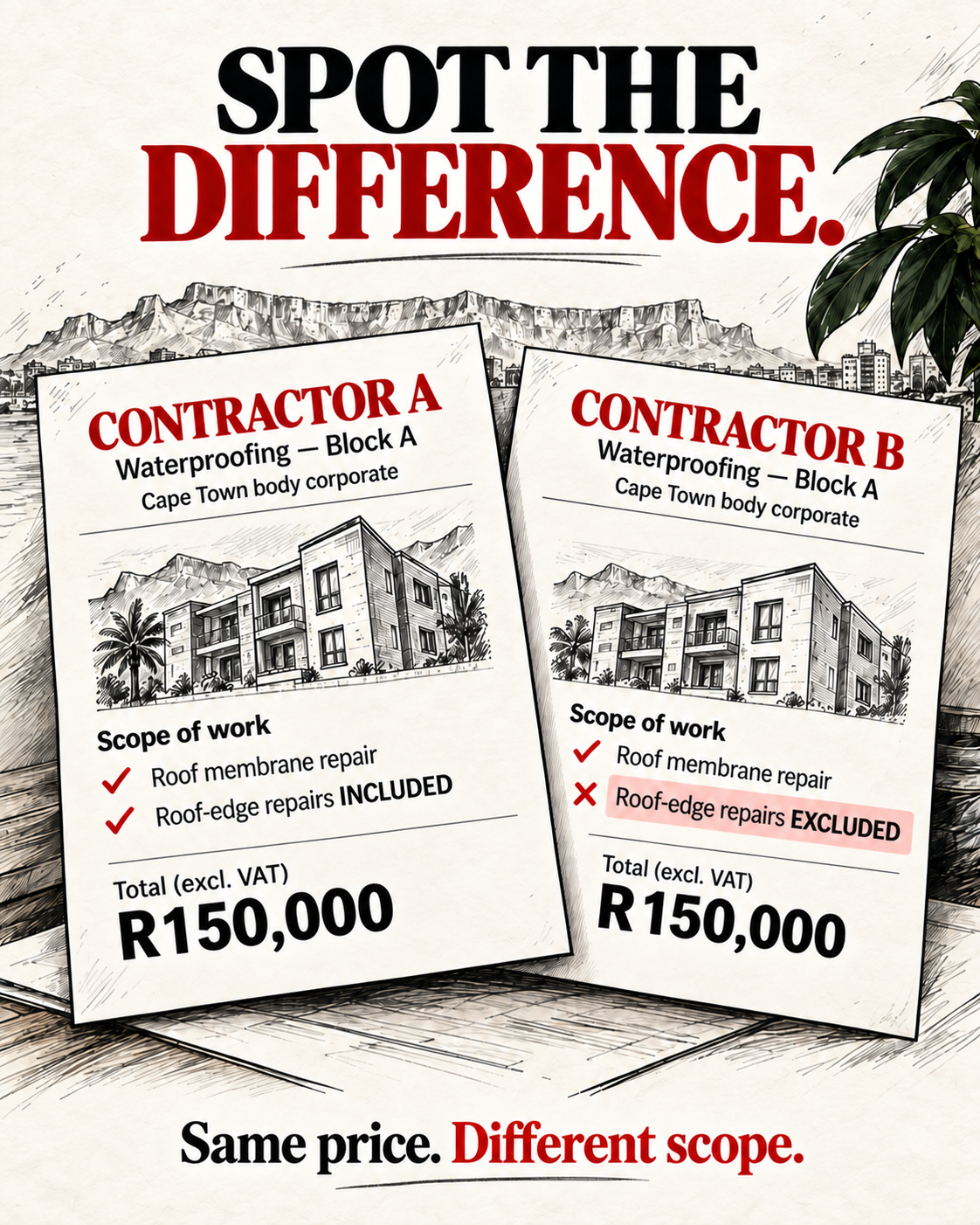
Same price. Different scope.
Consider a simple example. A Cape Town body corporate receives waterproofing quotations from two different contractors. Both total R150,000 excluding VAT. Contractor A includes roof-edge repairs. Contractor B explicitly excludes them.
A summary that says “two waterproofing quotations, both R150,000” is correct. It is also missing the point. The totals match, but the work included does not.
That difference needs to be read against the work the scheme actually requested. If roof-edge repairs are required, the exclusion needs clarification. If they are not, including them does not automatically make the other offer better. The comparison should expose the difference, not silently turn it into a recommendation.
On these simplified pages, the difference is easy to see. The harder test is when the relevant wording sits across several pages, exclusions and attachments. That is where I would judge AI: can it bring the important detail into view without losing the context?
Spot the difference—then show the evidence
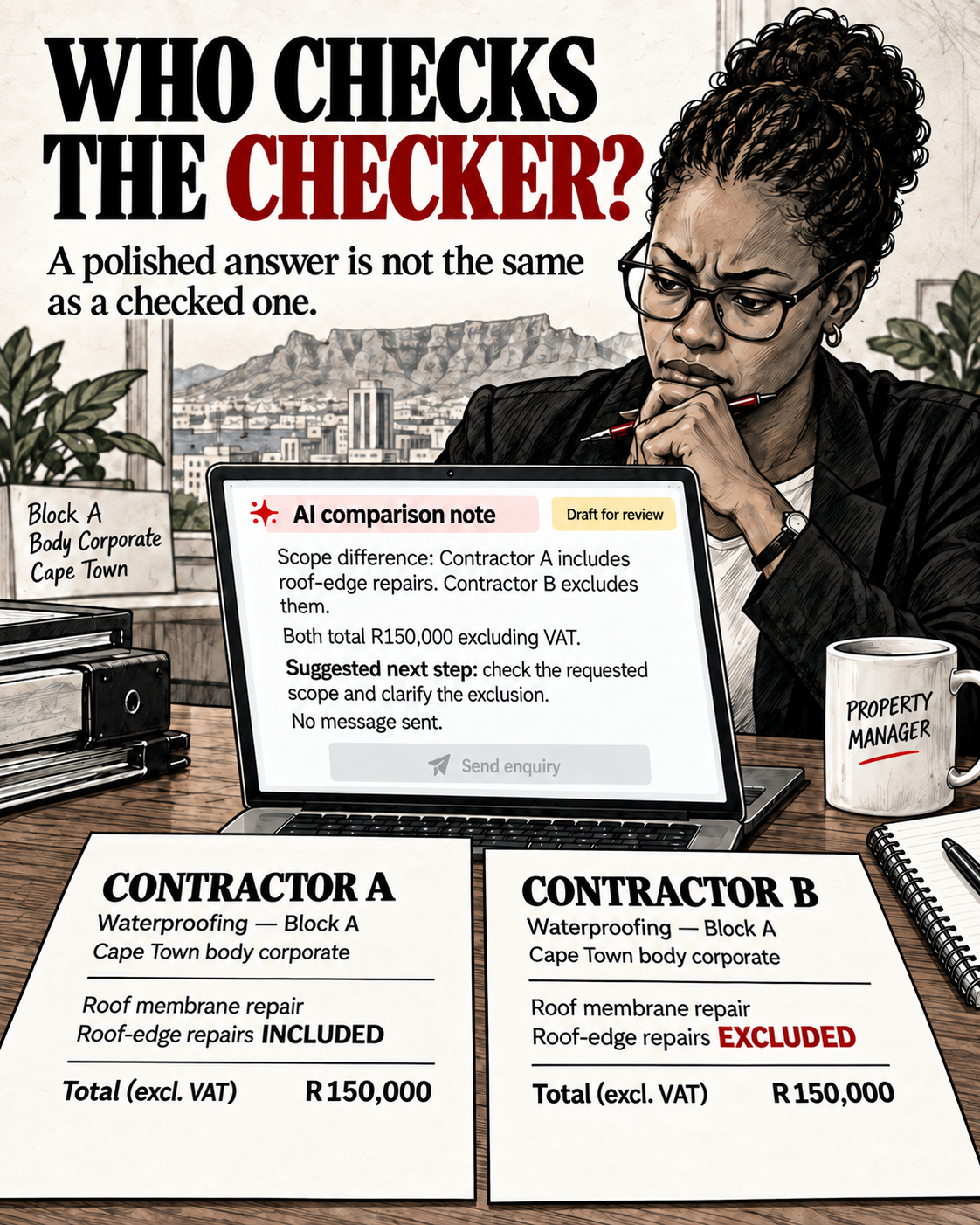
I would want an AI comparison to do three things: identify the difference, point to the relevant wording in each document and separate what is established from what still needs checking. In this example, a useful draft note might read:
Scope difference: Contractor A includes roof-edge repairs. Contractor B excludes them. Both total R150,000 excluding VAT. Suggested next step: check the requested scope and clarify the exclusion. No message sent.
The reviewer should be able to check that finding against the quotations themselves, with the document names, dates and relevant passages easy to locate. A confident conclusion without that evidence simply gives someone another statement to investigate.
It should also be clear which documents were checked. A comparison based on a quotation without its referenced schedule is incomplete. The system should flag the missing schedule, not present the result as a complete account of the work.
Not mentioned is not the same as excluded
Now change one detail in the example. Contractor B says nothing about roof-edge repairs. That is a different finding. The correct note is “roof-edge repairs are not specified in the documents checked”, not “roof-edge repairs are excluded”.
An explicit exclusion, an omission and an unreadable page are three different situations. Each calls for a different explanation. Useful AI should preserve those distinctions instead of filling the gaps with a plausible answer.
The reverse matters too. Different wording does not necessarily mean different work. A heading, layout or phrase may change while the underlying commitment stays the same. A system that highlights every textual difference without helping distinguish substance from presentation is adding to the review burden.
The test is not how many differences AI finds. It is whether it helps us understand the ones that matter—and is clear about what it cannot establish.
Who checks the checker?
The comparison is also a document that needs checking. AI might miss a footnote, confuse two buildings or attach the right statement to the wrong contractor. An attractive summary should make the evidence easier to inspect, not make inspection feel unnecessary.
A February 2026 research preprint offers a useful caution. In one controlled study, 12 technology-company employees reviewed completed agent tasks. A redesigned interface reduced error-finding time when errors were correctly detected, but did not meaningfully improve overall accuracy; confidence also increased when participants were wrong. This was a small interface study using prepared annotations, not a property-management trial.
My takeaway is straightforward: a polished answer is not the same as a checked one. The reviewer needs access to the source documents and room to question what the system has highlighted—or left out.
Finding a scope difference does not establish which contractor should be appointed, whether the repair is technically suitable or whether either price is fair. Those questions require their own assessment. For a waterproofing solution, that may include a suitably qualified professional.
Preparing a question is also different from sending it. I would keep correspondence and appointments behind explicit human approval, with the distinction between a draft and an action visible to the person reviewing it.
Five checks before trusting a comparison
- Are we comparing the right records? Check the building, job, document dates and versions. Identify missing attachments or pages that could not be read.
- Can I find the evidence? Each important finding should point back to the wording that supports it, with enough surrounding context to check its meaning.
- Is it a difference, a gap or an assumption? Keep an explicit exclusion separate from an item that is merely not specified. Do not treat different wording as proof of different meaning.
- Why does it matter here? Relate the finding to the requested work or the question being asked. Do not turn a scope comparison into an unsupported verdict.
- What happens next, and who decides? Make the unresolved question and proposed next step clear. Keep the reviewer in control of any message, instruction or appointment.
A better test than a polished demonstration
Try a small test with purpose-made sample documents, disconnected from live correspondence and payments. Put the requested work alongside the two quotations and write down the differences you expect a careful reviewer to find before testing the system.
A starting instruction for that test:
Compare these documents against the requested scope. Identify material differences and show the supporting wording. Separate explicit exclusions from items not specified. Flag missing or unreadable information, and list the questions that need answering before a decision.
Use the same-price example first. Then try a version where the item is not mentioned, one where the wording changes but the meaning does not, and one with a missing attachment. A useful system should not give the same confident answer to all four.
Check missed differences, incorrect flags, evidence quality and the time needed to verify the result. Compare that with your current review process. If every finding needs to be reconstructed from scratch, the claimed time saving needs a closer look. Repeat across several cases rather than judging the system on one successful demonstration.
Before using actual scheme records, agree what information the provider receives, who can access it and how it is retained and used. Keep personal information out of an informal test.
Better information, better questions
This does not require every comparison to become an autonomous agent. Anthropic’s guidance on building effective agents recommends starting with the simplest adequate solution. I would apply that principle here: use the level of assistance the task needs, and assess the result rather than the label.
At PropAI, quotation-comparison and AI-assisted review workflows are already available to clients. The standards above are what I would hold our own work to: clear differences, checkable evidence and useful next questions.
I will bring that practical perspective to “AI in Action: Moving Beyond Hype” at the Africa Proptech Forum on 18 September 2026.
Good property AI should not simply shorten the reading. It should help us notice what deserves a closer look.
Sources and further reading
Overseeing Agents Without Constant Oversight: Challenges and Opportunities — Grunde-McLaughlin and colleagues, 18 February 2026, version 1 preprint, especially section 5. Research context for the discussion of human review, not an evaluation of PropAI.
Building Effective Agents — Anthropic, 19 December 2024. The principle of starting with the simplest adequate solution.
Africa Proptech Forum — API Summit. Event information; speaker participation confirmed by Gustaf Cerette.