
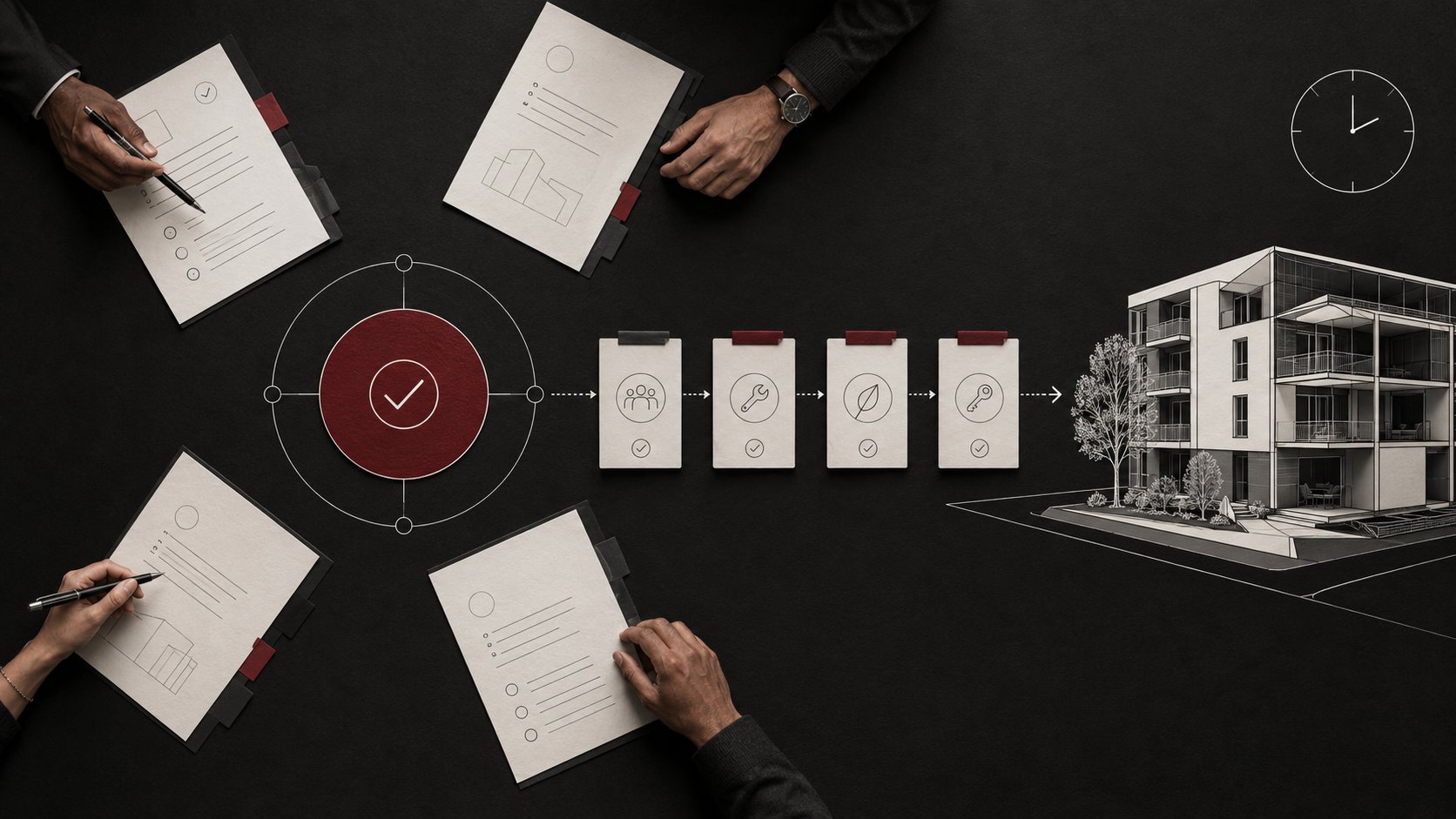
A successful trustee meeting is measured by what gets resolved and what happens afterwards.
Many trustee meetings follow a familiar pattern. The same maintenance problem is discussed again. Trustees work through a long list of updates. Quotations are mentioned, but nobody is certain whether the meeting is expected to approve one. The meeting ends with ‘managing agent to follow up’ recorded against several items.
Four weeks later, much of it returns to the agenda.
Trustee meetings should help a body corporate make progress. Trustees need the right information, a clear decision to consider and confidence that approved actions will be carried through. That requires a reliable process before, during and after every meeting.
Before the meeting
1. Build the agenda around decisions
Broad headings such as ‘Maintenance’, ‘Financials’ and ‘Owner Complaints’ give trustees very little indication of what they need to prepare for.
Compare these two agenda items: ‘Waterproofing’ and ‘Roof waterproofing: appointment of contractor and approval of R48,500 expenditure’. The second version immediately tells trustees what the meeting needs to decide.
It also helps to classify each agenda item:
- For decision: The trustees must approve or reject a specific proposal.
- For discussion: Trustee input is needed before a recommendation can be finalised.
- For noting: The item is an update and does not require a decision.
This prevents routine updates from taking up time that should be used for important decisions. Before placing an item on the agenda, ask:
- Why is this matter being raised now?
- What do the trustees need to decide?
- Do they have enough information to make that decision?
- Does the decision fall within the trustees’ authority?
If nobody can explain what the item is meant to achieve, it is probably not ready for the agenda.
2. Give trustees a meeting pack they can actually use
Trustees cannot make informed decisions when important reports or quotations arrive during the meeting. The prescribed rules ordinarily require at least seven days’ written notice of a trustee meeting, together with the time, place and agenda. Shorter notice may be given when the matter is urgent.
These are the ordinary prescribed-rule positions for sectional-title bodies corporate. Registered rule amendments and the circumstances of a particular scheme may affect the process.
Good preparation should go further than simply meeting the notice requirement. For every important decision, the meeting pack should include:
- A short explanation of the issue.
- Relevant background or previous decisions.
- Quotations, reports or supporting documents.
- The available options.
- The expected cost.
- The proposed source of funding.
- Any risks or time constraints.
- A recommendation.
- The decision required from the trustees.

The most useful format is often a short decision summary supported by the relevant attachments. Trustees should not have to reconstruct the history of a matter from a long email chain. The meeting pack should give them enough information to understand the issue and form a view before the meeting begins.
3. Decide whether the item is ready
Not every matter will be ready for approval. A contractor may still need to inspect the property. A quotation may exclude important work. The budget may not have been confirmed. Professional advice may still be required.
If the trustees do not have enough information, the agenda should say so. The purpose of the discussion should then be to determine:
- What information is still required.
- Who will obtain it.
- When it must be provided.
- Whether the matter can be resolved by written trustee resolution.
- Whether it must return to the next meeting.
Deferring a decision is sometimes the responsible outcome. The problem arises when an item is deferred without a clear plan for getting it ready.
4. Deal with the governance basics
Before decisions are taken, the chairperson should confirm that the meeting is properly constituted. This includes checking:
- Whether proper notice was given.
- Whether a quorum is present.
- Who is attending and in what capacity.
- Whether anyone is attending electronically.
- Whether a trustee has a personal interest in an agenda item.
A quorum for a trustee meeting is generally 50% of the trustees by number, but not fewer than two. A trustee with a direct or indirect personal interest in a matter must not participate in its consideration or decision. It is better to identify and record the conflict before the discussion starts.
Trustee meetings are also not automatically private. Members, registered bondholders, holders of future development rights and the managing agent may attend and speak on agenda items, although they may not propose motions or vote. Attendance can be restricted during certain sensitive discussions, including rule contraventions and matters where someone’s privacy or the body corporate’s interests could be unreasonably affected.
Electronic meetings must allow everyone entitled to attend to participate, communicate with one another and be identified with reasonable certainty. These checks only take a few minutes and can prevent arguments about the validity of a decision later.
During the meeting
5. Chair each item towards an outcome
At the start of every important item, the chairperson should state the decision or outcome required. For example: ‘The trustees need to decide whether to appoint one of the two waterproofing contractors, request revised quotations or postpone the work.’ This gives the discussion a clear purpose.
The chairperson should then keep the conversation focused on the information needed to reach that outcome. This may involve:
- Asking for the recommendation to be stated clearly.
- Separating confirmed facts from assumptions.
- Checking that the trustees have the necessary authority.
- Confirming whether funding is available.
- Bringing the discussion back when it moves away from the issue.
- Stopping repeated arguments that are no longer adding anything.
- Recognising when further information is required.
Every item should end with one of four outcomes:
- A decision was approved.
- A proposal was rejected.
- More information is required, with responsibility and a deadline assigned.
- The matter was noted and requires no further action.
‘Discussed’ is not an outcome.

6. Record the actual resolution
A general note that the trustees ‘agreed to proceed’ can create problems later. What was approved? Which quotation was accepted? How much may be spent? Are there conditions? Who is authorised to appoint the contractor?
For example, a resolution might read: ‘The trustees resolve to accept ABC Waterproofing’s quotation Q104 dated 22 July 2026 for R48,500 including VAT. The expenditure will be funded from the approved maintenance budget. The managing agent is authorised to appoint the contractor once proof of insurance and the proposed starting date have been received.’
This example is fictional and must be adapted to the scheme’s actual authority, quotation, funding and conditions.
Where relevant, the resolution should record:
- What was approved.
- The contractor, quotation or document concerned.
- The approved amount or spending limit.
- The source of funding.
- Any conditions that must first be met.
- Who is authorised to implement the decision.
- The result of the vote.
The wording should be confirmed before moving to the next agenda item. This is much easier than trying to reconstruct the decision while preparing the minutes.
7. Give every action an owner and a deadline
Where the meeting assigns an operational action, a responsible person and target date make follow-up easier to manage. These are management controls, not a substitute for any formal time requirement.
‘Managing agent to follow up’ is too vague to manage properly. A useful action must state:
- What must be done.
- Who is responsible.
- When it is due.
- What information or approval is still required.
- When the trustees will receive an update.
For example: ‘Managing agent to issue the contractor appointment by 18 August, subject to receiving proof of insurance. Confirmation to be sent to trustees by 20 August.’ The responsible person may be the managing agent, a trustee, contractor, attorney, accountant or another professional. What matters is that the next step belongs to someone.
An action without a responsible person or deadline is likely to become another discussion at the next meeting.
After the meeting
8. Keep the minutes focused on the formal record
Minutes do not need to reproduce every comment made during the meeting. They should provide an accurate record of:
- The date, time and place of the meeting.
- Who attended and in what capacity.
- The resolutions adopted.
- The result of voting on each motion.
- Any declarations of interest or recusals.
- The actions that follow from the decisions.
The prescribed rules require trustee meeting minutes to be distributed to those entitled to notice as soon as reasonably possible, but no later than seven days after the meeting. Circulating the minutes promptly gives trustees an opportunity to identify any misunderstanding before work proceeds on the wrong basis.

9. Use an action register for follow-through
The minutes record what happened at the meeting. The action register manages what must happen next. It should show:
- The matter.
- The decision or instruction.
- The responsible person.
- The due date.
- The current status.
- Any reason for delay.
- The next step or update date.
The action register should remain active between meetings. Completed actions should be closed with confirmation of what was done. Delayed actions should record the reason and the revised next step. Matters requiring a further trustee decision should be brought back with the necessary information.
Trustees should not have to wait for the next meeting to discover that a contractor never responded or an instruction was not issued. This is where good meeting management proves its value. The meeting creates the authority to act. Consistent follow-through turns that authority into progress.
Complete a final check before closing
Before ending the meeting, take a few minutes to confirm:
- What was approved?
- Is the resolution clear enough to implement?
- Who is responsible for each action?
- When is each action due?
- Is the necessary authority and funding in place?
- Are there any conditions that could delay implementation?
- When will trustees receive the next update?
If these questions cannot be answered, the item is probably not finished.
Meetings should reduce uncertainty
Trustees give up their time to make decisions for the scheme. They should leave a meeting knowing what was approved, what happens next and where their further input is required. A strong meeting process connects preparation, decision-making and implementation. The agenda identifies the decisions required. The meeting pack provides the necessary information. Resolutions are recorded clearly. Actions remain visible until they are completed.
PropAI’s intended meeting process connects preparation, clear resolutions and the management work that follows. The exact meeting and post-meeting scope is confirmed in the management mandate.
Are the same unresolved matters returning to your trustee agenda month after month? Request a management proposal from PropAI.