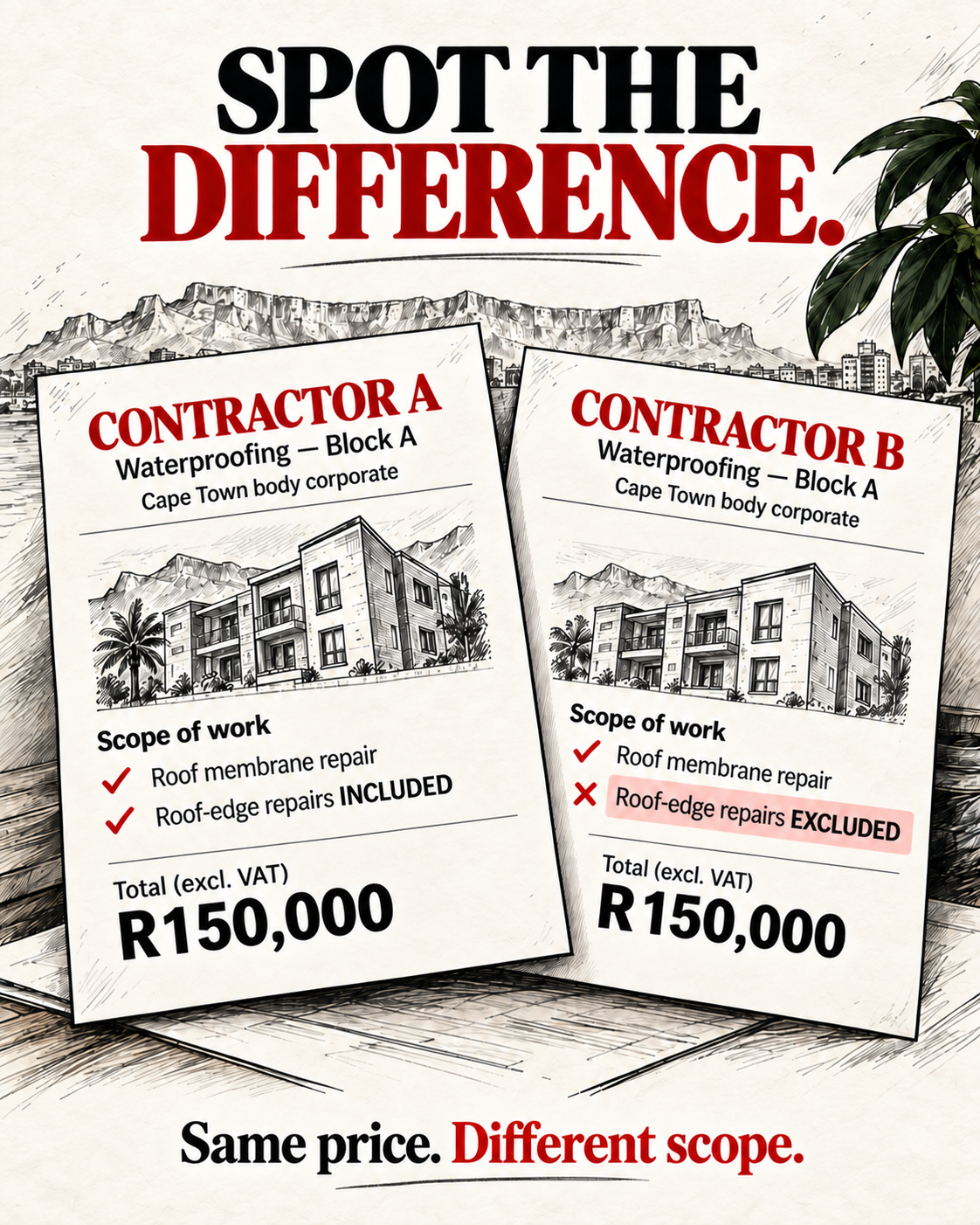

The levy increase should be the result of the budget, not the number used to shape it.
Budget time puts trustees in a difficult position. Owners want levies to remain affordable. Trustees know that insurance, municipal services, contractors and maintenance still need to be paid.
No trustee wants to propose an unnecessary increase. However, starting with a comfortable percentage and adjusting the expenses until they fit is not responsible budgeting. It simply hides costs that the scheme will still have to face later.
Before recommending the budget to owners, trustees should complete these seven checks.
1. Compare the budget with what was actually spent
Last year’s budget is only a starting point. What the scheme actually spent tells a more useful story. Look at every significant difference and ask:
- Why was this item over or under budget?
- Was it a once-off cost?
- Has the monthly cost permanently increased?
- Was money saved, or was work simply postponed?
An underspend is not always good news. If planned maintenance was not completed, that cost has probably moved into the next financial year. Trustees should understand the reason behind the difference, not just the percentage.
2. Check the important costs individually
Applying the same inflation percentage to every expense may be quick, but it rarely produces an accurate budget. Insurance, electricity, security and professional fees do not necessarily increase at the same rate. The larger expenses should be checked against current information, including:
- Existing service agreements.
- Renewal notices.
- Municipal tariff increases.
- Recent invoices.
- Updated quotations.
- Salary or wage adjustments.
Where the final cost is not yet known, record the assumption used. Trustees should be able to explain where the important figures came from.
3. Make sure maintenance has not been left out
Maintenance is often reduced first when trustees are trying to limit the levy increase. The problem is that removing a repair from the spreadsheet does not remove the problem from the building.
Check whether the budget includes:
- Routine maintenance expected during the year.
- Repairs already reported but not completed.
- Recurring leaks, equipment failures or other known problems.
- Required inspections and professional reports.
- Work included in the maintenance, repair and replacement plan.
Trustees should also understand which costs belong in the administrative fund and which major projects will be funded from the reserve fund. Postponing necessary maintenance may make the budget look better today, but it can result in emergency work, insurance problems or a special levy later.

4. Review arrears and available cash
A budget can balance perfectly while the body corporate still struggles to pay its bills. This usually happens because budgeted levy income and money received are treated as if they are the same thing.
Trustees should know:
- How much owners currently owe.
- Whether arrears are increasing or reducing.
- Which accounts have been handed over for collection.
- What action is being taken on newer arrears.
- How much cash is available after current commitments.
- Whether any suppliers or municipal accounts are overdue.
An arrears report without clear collection steps is not enough. Arrears should be considered in the body corporate’s cash-flow planning. The scheme may raise enough income on paper and still face pressure if that money is not collected on time.

5. Test the reserve fund against the maintenance plan
The reserve-fund budget should reflect the building’s actual long-term maintenance needs. Trustees should not rely only on the minimum required contribution. A legally compliant contribution may still be inadequate for the work approaching.
Review the maintenance, repair and replacement plan and ask:
- Is the plan current?
- Are the cost estimates still realistic?
- Have recently identified problems been added?
- Has completed work been removed or updated?
- What major projects are expected over the next three years?
- Will the reserve fund have enough money when those projects become due?
A roof, lift or waterproofing project will not become less expensive because the reserve contribution was kept low. If there is a future funding shortfall, trustees should identify it early enough to respond properly.
6. Ask what happens if an assumption is wrong
A budget should be realistic, not optimistic. Trustees should consider what would happen if:
- Municipal tariffs increase by more than expected.
- The insurance renewal is significantly higher.
- A major item of equipment fails.
- A maintenance project costs more than estimated.
- Levy collections deteriorate.
- An unresolved compliance or legal matter requires professional assistance.
Trustees should test material assumptions and document how the budget will respond if a major cost or collection assumption changes.
7. Calculate the levy increase last
Once the operating expenses, cash flow, maintenance obligations and reserve-fund needs are understood, trustees can calculate the contributions required from owners. If the resulting increase is difficult, look for genuine savings:
- Renegotiate or retender selected services.
- Remove costs that are no longer necessary.
- Review whether the scheme is receiving value from its contracts.
- Phase non-urgent projects where this can be done responsibly.
- Correct inefficient systems or recurring unnecessary expenses.
What trustees should not do is remove necessary costs simply to reach a more popular levy increase. Keeping levies artificially low does not make the scheme less expensive to run. It delays the cost and often leaves owners with fewer options when the money is eventually needed.
What should trustees receive before recommending the budget?
Trustees should not be expected to approve a spreadsheet without the supporting picture. Before the AGM, they should ideally receive:
- The current budget compared with actual expenditure.
- A forecast of expected spending to the end of the financial year.
- Explanations for material variances.
- The assumptions used for major expenses.
- A summary of arrears, collection progress and available cash.
- Separate administrative and reserve-fund budgets.
- An updated maintenance, repair and replacement plan.
- A clear contribution schedule showing the effect on owners.
- A list of material risks or costs that have not been included.
Most importantly, trustees should be able to explain the proposed budget in plain language. If they cannot explain why the levy is changing, owners are unlikely to have confidence in the numbers.
A good budget gives owners fewer surprises
The best budget is not necessarily the one with the lowest levy increase. It is the one that gives the body corporate enough money to operate, maintain the property and prepare for known future costs. A well-prepared budget also makes the AGM easier. Trustees can explain what changed, why it changed and what the scheme is preparing for.
PropAI’s finance and reporting approach is designed to give trustees clear comparisons, stated assumptions and the decisions requiring attention. The exact reporting scope is confirmed in the management mandate.